
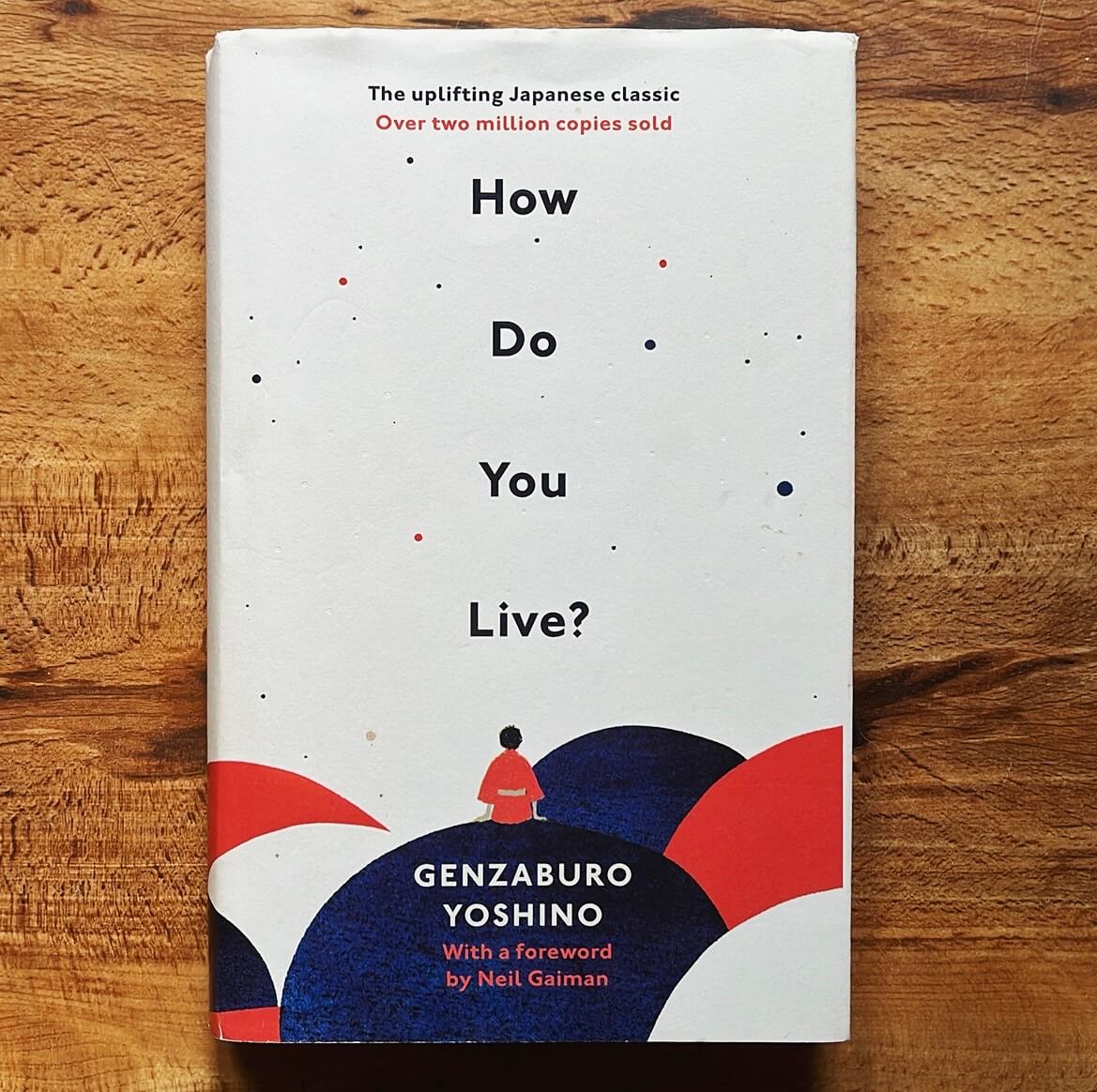
First published in 1937 in the glorious land of Nippon, 君たちはどう生きるか (Kimi-tachi wa Dō Ikiru ka) has since become a treasured Japanese classic. At a slight 298 pages, Genzaburō Yoshino (1899-1981) crafted a beautiful coming-of-age story about the young schoolboy Copper and his friends in 1930s Japan.
It wasn’t published in English until 2021 as How Do You Live?
At the time, the book was incorrectly promoted as the influence for the latest Studio Ghibli film. In Japan that ended up being called How Do You Live? That’s because it’s director Hayao Miyazaki’s favourite book from childhood. But in the West, it received the title The Boy and the Heron and launched in 2023. It has nothing to do with Yoshino’s book, although a copy of the book does receive a brief onscreen cameo.
That’s fitting enough as Yoshino’s book is an incredible work of empathy. Its exploration of how to lead a meaningful life is oh so prevalent to our era here in 2026, where a certain sociopathic billionaire claims empathy is a drawback for the species as he hoards vast reams of wealth in an obscene gesture of greed.
A cure to such a toxic mindset is Yoshino’s wonderful novel, an excellent read for all ages, and a work I think would be a guiding influence for younger people.
The Philosophy of Empathy in How Do You Live?
“People can forget their fear if a heroic spirit burns within them. Courage grows in a person, higher than any barrier, and then even your precious life becomes less precious. I think that’s the most fantastic thing. People becoming more than people.”
My favourite quote from this book is above, as said by the Napoleon mad female friend of main character Junichi “Copper” Honda. She has a small role in the narrative (one I cover in more detail further below), but her obsession with courage and nobility are major themes across the rest of the work.
As for Copper, his uncle gave him the nickname after Renaissance era polymath Nicolaus Copernicus. The young lad is showing a keen interest in science, is very smart, and so the uncle believes it to be suitable.
Readers meet a wonderful cast of young people in the book. Again, Copper is a very bright young mind, intrigued by the workings of physics, and eager to be a positive force in the world. In Neil Gaiman’s foreword to the English translation of How Do You Live?, he covers a few of these points (one of which I have an issue with).
“This is such a strange book and such a wise book. I wish I had been given it as a small boy, but I suspect I would have found it puzzling or even dull: a book-length essay about how we live our lives, interrupted by the story of a pre-war schoolboy in Japan dealing with friendship and bullying; or a story about growing up, bravery, cowardice, social class and finding out who you are, interrupted by essays about scientific thought and personal ethics.”
I find that odd as there’s not much “strange” about the work. It’s a coming-of-age story with scientific insights from Copper’s uncle, who has an avuncular outlook.
A strange media text is The Boy and the Heron and its surrealist, multi-layered concepts.
But anyway, Gaiman does raise the good point its status as classic of children’s literature is a little off. A person of any age can enjoy this book, but its life lessons may be lost on young minds more interested in expending excess energy, playing video games, and ram-raiding off licences (or whatever it is kids these days do).
Anyway, for the record, this is how the structure of the narrative goes:
- Copper’s thoughts on his daily life, schooldays, and societal societal inequality
- Copper’s uncle providing him life lessons on scientific insights through diary entries
It’s not explained how, but Copper’s father has died. He gets emotional support from his mother and his uncle has taken on a strong father figure approach to their relationship. And this really is how the narrative arc goes, Copper experiencing more about the world around him, with a keen interest in his friends, equality, and social injustice.
The book is about equality and how to bring that about into the world, with Genzaburō Yoshino a socialist (i.e. supporting everyone and everything across society with fair wealth distribution). As this April 2021 article by Penguin reveals, the writer was briefly jailed for this ideology: How a once-banned Japanese children’s book became a classic.
“In the interwar period of the 1920s and 30s, Japan was becoming increasingly militaristic and authoritarian … the government had created a special branch of the police, called the Tokkō, to uphold the Public Security Preservation Law, meant to squash any anti-authoritarian, perniciously Western ideas expressed in art, writing, speech or performance.”
That led to a crackdown on any dissenters.
“By the early 1930s, when he was 30 years old, the Tokyo-born Genzaburō Yoshino had enrolled at Tokyo Imperial University to study economics but graduated with a philosophy and literature degree. He then found work at the University of Tokyo library, where he became interested in politics and began to explore socialism. By 1931, he was imprisoned for 18 months for his involvement in socialist thinking.”
When WWII broke out two years after its publication, How Do You Live? was banned in Japan from 1942 onward. After WWII, it was re-published in 1945 but had its anti-capitalist, anti-imperialist, class issue leanings stripped out.
Modern reprints have restored most of the original writing, which includes the English translation in 2021. The book I’ve read here is a faithful version of what Genzaburō Yoshino intended.
Copper’s Journey: Compassion, Intellect, and Understanding
“For truly, just as you felt, individual people, one by one, are all single molecules in this wide world. We gather together to create the world, and what’s more, we are moved by the waves of the world and thereby brought to life.”
This is a very wise book. Neil Gaiman was right about that. Copper’s uncle is a wise, guiding spirit for the young lad and a great father figure. The character is Yoshino’s voice, speaking to the reader about what he believes to be a true and just world.
It’s curious reading the book now, in 2026, when the explosion of capitalist individualism and grandiosity (the Extrovert Ideal as Susan Cain calls it) is reaching disturbing new peaks. The self-absorption and focus on personal wealth over everyone else will be the continual undoing of humanity.
Cut back almost 100 years ago and Yoshino was writing about social injustice in the same way George Orwell wrote of wealth inequality in Down and out in Paris and London (1933). The Japanese writer had the same concerns, that self-obsession benefits the few.
“In the world at large, people who are able to free themselves from this self-centred way of thinking are truly uncommon. Above all, when one stands to gain or lose, it is exceptionally difficult to step outside of oneself and make correct judgments, and thus one could say that people who are able to think Copernicus-style even about these things are exceptionally great people. Most people slip into a self-interested way of thinking, become unable to understand the facts of the matter, and end up seeing only that which betters their own circumstances.”
How Do You Live? is about a magnanimous spirit. At the centre of its themes? Copernicus’ 16th century revelation the Earth wasn’t at the centre of the universe. His 1543 book De revolutionibus orbium coelestium (On the Revolutions of the Celestial Spheres) was landmark for its time, based around a heliocentric model, and triggered off the Copernican Revolution.
The book was delayed over 20 years, with the polymath not wanting to publish it until social/religious understanding would tolerate the theories. It was unfortunate coincidence he died, aged 70, shortly after the book launched.
Much later, the church threw a hissy fit and banned it in 1616. Galileo Galilei championed Copernicus in that era and wound up under house arrest for his efforts. He had a comfortable villa in Arcetri, near Florence, so it wasn’t the worst of fates, but did inhibit further exploration.
But this scientific battle of critical thinking, logic, and reason is what Copper’s uncle is on a mission with.
“Still, as long as we held fast to the thought that our own planet was at the centre of the universe, humanity was unable to understand the true nature of the universe—and likewise, when people judge their own affairs with only themselves at the centre, they end up unable to know the true nature of society. The larger truth never reveals itself to them.”
Through the innocent eyes of Copper, Yoshino soon explores Japan’s class structure. This is fairly similar worldwide, as we all know people who are poor, comfortable, or wealthy. Copper’s schoolfriend Fried Tofu (real name Uragawa) is from a poor family. He’s mocked by his classmates for always eating fried tofu, as the others in class believe this highlights his poverty (and, consequently, inferior status as a human being).
From this angle, Yoshino is able to take a narrative arc that explores the nature of being a good person, not least in how we treat others who are less fortunate.
An Existential Take on Morality in an Absurd Universe
Copper is very defensive of Fried Tofu and wants to learn about his life. The lad is often being absent from class as he needs to help his mother run the tofu café she owns. The uncle writes to Copper.
“What your mother and I want more than anything is for you to grow up into a good person. Those were also your father’s final wishes.”
This raises a philosophical question of what it means to be a good person, as certain sects of society have a different take. For example, some people genuinely believe financial success makes them a good person and life is about personal responsibility (true to some extent) and not relying on the state (although when the state lands 14 years of austerity on a nation, as just happened in the UK, all the personal responsibility in the world can’t overcome a failed economic system).
Anyway, if you’re an existentialist (such as myself) who is consigned to the absurdity of existence, and there’s no meaning to life, that does lead some to take disgust at such a stance. Yet in existentialist theory, the likes of Camus and Kierkegaard argue that within such a mindset is where you find morality, freedom, and joy. As in, we’re here for a brief time in the universe, so spend it being a good, morally sound human being for the benefit of everyone around you.
I was listening to one of our favourite podcasts recently (Kermode and Mayo’s Take) and, for the first time in 17 years of listening, I thoroughly disagreed with the opinions Mark Kermode and Simon Mayo have on existentialism. The hosts accused existentialists of needing to “grow up”. Their issues seemed more directed at nihilism than the absurd. Anyway, you can see the review here it was for the new adaptation of Camus’ The Stranger.
The guys are entitled to their opinions, of course, so I didn’t blow a lid and start raging away in the comments section. It was more about respecting their point of view, although I wish they’d expressed themselves in a better way.
Subsequent letters from fans of the show poured in and the hosts did address different points of view. However, these were laughed off and it was said the likes of Jean-Paul Sartre were miserable “tossers” (as Mr. Mayo put it). I was surprised by their rather savage feedback, as the pair are very smart. They are religious, though, which is why I flagged up the difference in “good” earlier. Everyone has a different concept, although I do think they have a misunderstanding on how the existential mindset works.
My branch of existential leaning is very much in the sense of being happy-go-lucky, looking out for one another, distribute wealth fairly across society FFS kind of deal. Whilst we have our moment on Earth, go around being a decent human being and support a collective approach to existence.
It does make me think, what is morality? For the record, PsychCentral argues six signs of a good person are:
- Empathy
- Compassion
- Kindness
- Altruism
- Integrity
- Inclusivity
Six things that capitalist society has shat the bed about over the last decade (“woke”). But how, in a meaningless universe (under the existential belief), can these be considered the right choices? Why isn’t, for example, going around stealing people’s cars, or punching everyone in the face, the better way to live?
Without empathy, we wouldn’t have made it this far as a species.
Hundreds of thousands of years ago, early humans had to work together to survive. Empathy is an essential survival tactic in evolution. You think of people in the neolithic period, if one of their troop broke a leg they wouldn’t abandon that person. They’d look after them and try to get them back to full health.
In other words, those six points are constructed by human society to stop life from becoming a living hell.
You take them away, as we’ve seen at certain points in the 20th century, and the result is a glimpse into the very worst of the human condition.
A big part of Jean-Paul Sartre’s Age of Reason and Roads to Freedom Trilogy is the focus on humanity condemned to be free. Within that belief, minus a deity, humans must invent values. If we want to get far as a species, those values need to be tolerant. The shift comes when there are people who don’t like doing that or have a sense of ideological superiority. For existentialists like Sartre, Camus, and Simone de Beauvoir, their ideology was a rebellious statement—of creating light to prevent existence from being dark and imposing.
It’s no surprise Yoshino was arrested for How Do You Live? He was on about not being a self-absorbed dickhead at a time when globalisation was surging forward and demanding it.
What we’re seeing in 2026 is the failure of the prevailing economic system. The public has lost trust in many systems that previously worked ok-ish and the lashing out, finding scapegoats, has begun. This, then, is why we know those six values are the right path, otherwise we get the very tangible rot that replaces them. None of this is written as lore in the universe and means nothing a thousand years from now, but the existential focus on the present is what binds a liveable experience together.
On True Experience
The uncle has one eye set on the future to ensure his nephew excels as a member of society. The way Copper thinks, his musings on the page, indicate he’s of high intellect. He may go far in life, but the guiding spirit of his mother and uncle need to get him there first. That means Copper has to make errors, as we all do in life, to learn from them and grow as a person.
“You must make a habit of thinking honestly, with your own experience as a foundation, and—Copper, this is very important!—if someone fakes this part, no matter what kind of great-sounding things they think or say, they are all lies in the end.”
The uncle continues.
“There are lots of people in the world who act just for appearance’s sake—to seem great in the eyes of others. That type of person worries first about how they are reflected in other people’s eyes, and they inadvertently end up neglecting their true selves, as they really are. I hope you don’t become that sort of person.
And that is why you absolutely must attend to the things you feel in your own heart, the things that move you deeply. That is what is most important, now and always. Do not forget this, and think carefully about what it means.”
Yoshino supports these insights with the uncle’s scientific knowledge, which he seems to have gone off and learned by himself (the thirst for knowledge and all that). Given this book was published in 1937, now almost 90 years ago, it shows an impressive commitment to contemporary happenings. Albert Einstein’s theories in the 1920s laid down incredible new concepts of the world around us, but the uncle is also keen to focus on Copernicus and Isaac Newton’s revelations about gravity.
“In Newton’s case it comes from taking an apple that has fallen from a height of three or four metres and lifting it, in his head, higher and higher, until he comes to a certain place and, with a thud, collides with a bigger idea.”
Yoshino here raises the need for continuous thinking, to find a higher plane of meaning. Super smart people, the geniuses of the world, can reach such incredible heights they reshape human history. For people on a lower plane, you can still read into these insights and shape your appreciation of the world and values (or reject it entirely, if that’s your mindset, because thinking is hard work for some). Here, Copper breathes in this information and looks on at the world in awe.
“So you see, Copper, the things that we call obvious are tricky. When you think about a thing as if were self-evident and follow it where it may lead, soon enough you run into a thing that you can no longer call self-evident. This is not only true when it comes to the science of physics…”
The moon was already a great deal higher. It gazed diagonally down at the four figures from above, silent as always. Above their heads spread the vast, limitless night sky, and the stars twinkled ceaselessly. On a night like this, to think about the distant celestial world was to feel that one was disappearing into the atmosphere.
Copper and his companions were suffused with pale light. The gravel covering the road along which the four of them were walking was drenched in moonlight and shone with a lovely glow.”
It highlights the importance of continued learning for people of all ages. This is not something you should abandon or feel you somehow know everything (or, worse still, take a stance of anti-intellectualism). Copper is in school, but he’s learning outside of it, too. This learning must never stop, it’s important to keep expanding your knowledge, whether you want to learn about physics or how to properly make a cup of tea. As in ignorance there lies an obstinacy that leads to what I call Back In My Day Syndrome (BINMDS). What’d be classed officially as a cognitive bias in the form of Dunning-Kruger effect, or selective memory distortion (rosy retrospection, as it’s proposed in psychology), in the form of denial, to prop up a false sense of happiness (i.e. rambling about The Good Old Days).
As I’ve got older, I’ve found my knowledge of culture lends itself well to younger people I’ve met (usually in work). You can recommend books or films to watch, and music to listen to, and they go off, learn, and enjoy themselves. It’s an avuncular thing… have I turned into Copper’s uncle!?! It wouldn’t be a bad thing. when a man such as Yoshino thinks like this.
“There is nothing more beautiful than people nurturing goodwill toward their fellow beings. And those are the human relations that humans deserve. Copper, don’t you agree?”
Culture has the highest of values, as Simone de Beauvoir put it, and it’s so important for people of all ages. But particularly young minds, which is why it’s so damaging and toxic to see that eroded in this social media era. There’s a contradiction now, as certain aspects of The Good Old Days were better. Just not in the Conservative sense of “traditional values”, but capitalism was working okay 30 years ago, people were being educated reasonable well, and university was much more affordable.
Now, in late-stage capitalism, we’re seeing all of that slipping away. As Yoshino did in his era, which is why he leans to heavily into the concept of personal and societal courage.
On Napoleon and Poverty
Copper meets his friend Mizutani’s sister, Katsuko, 105 pages into the book. She’s a very confident girl, obsessed with Napoleon, and full of wild postulating about bravery, dedication, and valour. Although she’s not in the story much, she sticks with you (she did with me, anyway) for her intense opinions and clear vision on what she considers to be noble personality traits.
“With a ferociously calm look on her face, she advanced toward them, step by step, looking exactly as if she were the class valedictorian advancing to receive her diploma at the podium.”
It’s noted she looks like she’s in the fifth or six grade. Copper is a kid, so there’s no romantic attraction or anything like that, but he is taken aback by her confidence. Some people just have an aura about them, even from a young age. And she rants a lot about Napoleon and how he was brave and magnificent. Copper relays this information to his uncle, he has more insights.
“The world is full of people who are not bad, but weak, people who bring unnecessary misfortune upon themselves and others for no reason but weakness. A heroic spirit that’s not devoted to human progress may be empty and meaningless, but goodness that is lacking in the spirit of heroism is often empty as well.”
This is where class structure and wealth inequality come into focus. Yoshino’s values are laid very clear.
“Of course there are also magnificent people who take rightful pride in themselves as they live their lives, despite the fact they are poor. But many in this world seem to lose their self-respect in the presence of the wealthy and instead bow and scrape blindly, as if they wonder whether they are complete equals. These people, of course, deserve contempt. Not because they have no money. It’s because their servile nature allows no alternative.”
I’ve seen this a lot in the social media era, especially with the skyrocketing numbers of billionaires over the last 10 years. Despite such obscene greed, you’ll see on social platforms people earning very little mindlessly defending the superrich and treating them as the saviours of the universe.
There’s a great quote by Canadian author Ronald Wright about this in his book A Short History of Progress (2004).
“John Steinbeck once said that socialism never took root in America because the poor see themselves not as an exploited proletariat but as temporarily embarrassed millionaires.”
A statistic from summer 2022 states 44% of Americans still think they’ll end up billionaires. The capitalist system tells us all it’s doable through “hard work”, but the reality is it takes a phenomenal amount of luck and greed to achieve that status. And with the likes of Amazon now monopolising multiple industries, the chances are increasingly slim. But we have, as a society, had it drummed into us to view the wealthy as superiors who prop up society and deserve their status.
The psychological impact on people less well off (as in, 99% of the rest of the world) is considerable. Copper’s uncle waxes lyrical on how to approach this detachment from extreme wealth.
“So in theory, then, saying someone is poor shouldn’t make them feel small. It should go without saying the true worth of a person doesn’t depend on that person’s clothes or house or food. No matter what kind of magnificent garments they wear or grand mansion they inhabit, fools are fools, boors are boorish, and their value as people shouldn’t be elevated for those reasons.”
Japan’s class structure isn’t something I’m well read on, but here in England it’s all prevailing. As is the desire to be rich, with that viewed as success in life, and that social mobility is possible through the “hard work” and “personal responsibility” angles. I’ve increasingly moved away from that as I’ve got older, I can’t weigh up having, for example, £100 million in your bank account when you don’t need all that money. The people who do have it, sit on it and there it is, doing nothing, whilst tens of millions worldwide struggle. Then they’re told “if you’re poor, you should work harder” as part of this erroneous capitalistic mindset. The blame of the person, not the system.
Georg Rockall-Schmidt, a brilliant social commentator, created this important 2022 video on how wealth changes people.
In How Do You Live? we find the reasoning that belongs to a gracious society.
“Of course, you went to Uragawa’s house and didn’t act like you were above him in the slightest. I know full well that right now you would never look down on the poor. However, what you still don’t know is how important it is to hold on to that attitude as you become an adult.
But I think I will take this opportunity to let you know just how important it is. The better you understand the world, the more important this will become. Or, rather, its importance is something you must never forget if you want to understand the world properly at all.
As for why this is so—please remember this well—it’s because in the world today, the vast majority of people are poor. So the vast majority of the people in this world are unable to live their lives in a way that is really human—this is the problem of our time, greater than any other.”
The uncle then highlights Uragawa’s situation is much better than many other people’s in Japan and the world.
“Copper! You have read both volumes of How Many Things Have Human Beings Done? You know the glorious history of human struggle. How for tens of thousands of years we piled effort upon effort to advance at last from our primitive life in ancient times to our current civilization.
But today, the fruits of those labors are not awarded to everyone …
It’s wrong for sure. We are all human beings, so f we can’t all live a life that is really human, something is wrong. A society that doesn’t allow that is wrong. Nobody can deny this, as long as they have an honest heart.
Today, no matter how shameful it seems, our society is not there yet. One might say the human race has progressed, but we still haven’t made it that far. This remains a problem for now and the days to come.”
And that brings me back to Katsuko and her fascination with Napoleon Bonaparte. That plays out in the fifth chapter (Napoleon and the Four Young Men) that ties in with Yoshino’s thematic arc on the nature of human greatness/progress. That alongside the dangers of empty heroism and the waste that is self-centred ambition.
That’s where the quote about the human spirit, back at the start of this feature, is used.
“I think that’s the most fantastic thing. People becoming more than people.”
The idea of cultivating your courage and refusing to succumb to fear, alongside the greatness vs goodness concepts Yoshino focusses on. And it’s fear that causes Copper one of his great coming-of-age moments.
Copper’s Cowardice
In the closing stages of the novel, a notable incident occurs with Copper at school. His friends leap to defend one another from some bullies, but he’s scared and stays rooted to the spot, despite having previously pledged they’d all stick up for each other.
In the aftermath, he’s ashamed of himself and guilt-ridden to the extreme. It races through his mind day and night, not helped by an extended illness with the flu, until he seeks further advice from his mother and uncle. Both offer excellent life advice, with the uncle calling for Copper to take accountability for his actions and right some wrongs.
His mother also provides an intriguing story. This is of when she was younger and walking up some steps, with ahead of her an old lady carrying items. Copper’s mother wanted to help her, but was hesitant, and it was if the right moment didn’t present itself to offer assistance.
“The old woman reached the top of the stairs, never dreaming I was right behind her, worrying myself with these thoughts. She lowered her heavy bundle onto a nearby stone bench, and for a while, as if she had completely forgotten to sit down herself, looked down over the town below, leaning on her umbrella and breathing deeply, shoulders heaving.
And when I walked by, she glanced in my direction briefly but then quickly turned away again, looking not particularly interested. And in spite of that, it’s strange, you know, but for my part, I remember her face perfectly even now!
Jun’ichi, dear. That’s all there is to the story. But even all these years later, I still sometimes remember what happened then. Yes, I remember all sorts of feelings, at all sorts of times.”
Copper’s mother became quiet for a while. And then, while her hands busied themselves with her knitting needles, she seemed to be remembering some far-off thing, but presently, quietly, she began to speak again.
“I couldn’t help but notice the old woman’s weary state, and while I thought that I should carry her heavy bag for her, I only thought to deep inside and in the end was unable to do it—well, the story is just that, but it made a strangely deep impression on my heart.”
A simple anecdote, but one about regret and human weakness, whilst also highlighting human flaws and failures as normal. Good intentions versus the right actions, plus reconciling on these moments and using them for personal growth. Being very bright, there’s no surprise as the novel winds to a conclusion that Copper makes amends
This is a very real thing we’ve all experienced, those moments in life you cling to in your memory unhappy about what might have been. How you wish you’d done the “proper” thing and desire to go back in time to act the way you wanted. People may have hundreds or thousands of such moments across their lives.
You can’t cut them all out, but you can continuously build on them to become a more complete person.
At the End of it All, Genzaburō Yoshino’s Essential Lesson
How Do You Live? has much more about it than a simple book for children. Its philosophical depth is impressive across less than 300 pages, demanding a re-read to make the most of its message.
Yoshino’s message is one for the ages. Greatness doesn’t belong to conquerors, the elite, or the superrich. It comes from people who have a magnanimous desire beyond self-absorption and individualism. And to remain connected to goodness, no matter what occurs in life. Modern economic life doesn’t reflect these values. In many respects, it’s an age of extreme arrogance. But when you read books like this, you can find a cathartic release and a literary way toward a life well lived.

@moonshakebooks.com The inviting foreword by Neil Gaiman aged better than the man himself. Great read. #bookstodon and definite #recommendation for a peek into a very different world.
LikeLiked by 1 person
Remote Reply
Original Comment URL
Your Profile
Why do I need to enter my profile?
This site is part of the ⁂ open social web, a network of interconnected social platforms (like Mastodon, Pixelfed, Friendica, and others). Unlike centralized social media, your account lives on a platform of your choice, and you can interact with people across different platforms.
By entering your profile, we can send you to your account where you can complete this action.
I’ve not read much of Gaiman’s works to be honest, but it’s an intriguing and brief foreword. Maybe I’ll try one out, I need a new book to start.
LikeLike